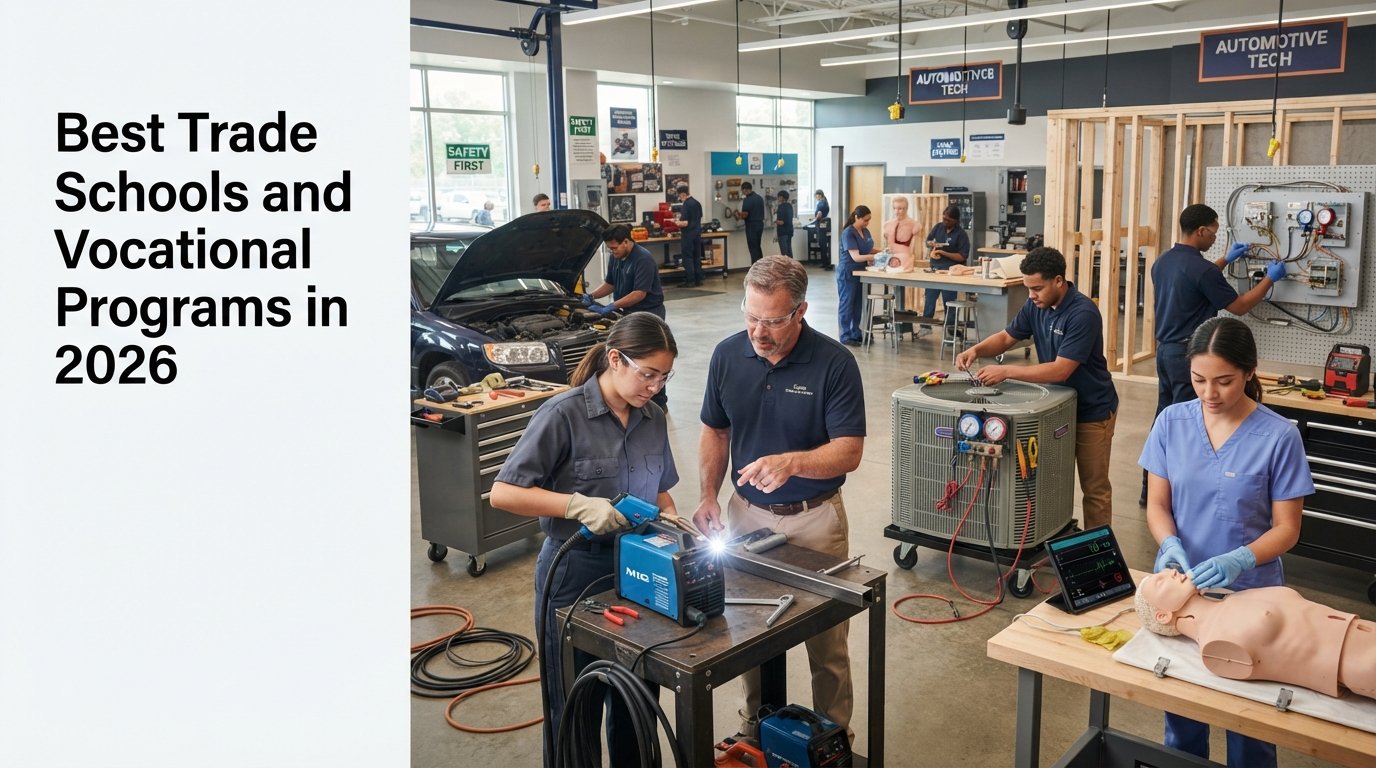
Trade schools and vocational programs have become an increasingly practical alternative to traditional four-year college programs. For students who want career-focused training, hands-on experience, and a potentially faster route into the workforce, skilled trades can offer attractive opportunities.
Unlike traditional degree programs that may require several years of broad academic study, many trade schools concentrate on specific occupations. Students can train for careers in healthcare, technology, construction, automotive services, electrical work, plumbing, welding, aviation, and other specialized fields.
However, choosing the right program requires more than looking at tuition or program length. Accreditation, licensing requirements, graduation rates, job placement, hands-on training, program quality, and long-term earning potential all deserve careful consideration.
This guide explores some of the best trade school and vocational program options in 2026 and explains how to choose a program that fits your career goals.
What Is a Trade School?
A trade school, also called a vocational or technical school, provides career-specific education designed to prepare students for particular occupations.
Programs typically emphasize practical skills rather than broad academic coursework. Depending on the field, students may spend significant time working with equipment, tools, technology, laboratories, or simulated workplace environments.
Common trade school programs include:
- Electrical technology
- Plumbing
- Welding
- HVAC
- Automotive technology
- Medical assisting
- Dental assisting
- Practical nursing
- Radiologic technology
- Information technology
- Cybersecurity
- Computer networking
- Culinary arts
- Aviation maintenance
- Construction technology
- Massage therapy
- Cosmetology
Program length varies considerably. Some certificates can be completed within months, while diploma and associate-level programs may take one to two years or longer.
Why Consider a Trade School in 2026?
Trade schools can offer several advantages for students who prefer career-focused education.
Shorter Training Periods
Many vocational programs take less time to complete than a traditional bachelor’s degree. This can allow graduates to enter the workforce sooner.
Hands-On Learning
Students generally spend more time developing practical skills related to their chosen occupation.
Career-Specific Education
Rather than completing extensive general education requirements, students focus primarily on skills relevant to their intended profession.
Potentially Lower Education Costs
Shorter programs can sometimes cost less overall than four-year degrees. However, tuition varies substantially between institutions, so students should compare the total cost rather than assuming vocational education is always inexpensive.
Demand for Skilled Workers
Many industries depend on trained technicians and skilled professionals. Construction, healthcare, maintenance, transportation, technology, and other sectors continue to require workers with specialized skills.
Best Trade School Programs in 2026
The best program depends on your interests, location, educational background, and career objectives. The following fields are among the most practical areas to investigate.
1. Healthcare and Nursing Programs
Healthcare is one of the largest vocational education categories.
Programs may prepare students for careers such as:
- Licensed practical or vocational nursing
- Medical assisting
- Dental assisting
- Surgical technology
- Pharmacy technology
- Medical laboratory technology
- Radiologic technology
- Emergency medical services
Healthcare programs can be attractive because they offer multiple career paths and opportunities for advancement.
However, many healthcare occupations require state licensing, certification, clinical training, or examinations. Always verify the requirements for the occupation and location where you intend to work.
2. Electrical Technology Programs
Electricians install, maintain, troubleshoot, and repair electrical systems in residential, commercial, and industrial environments.
Training commonly covers:
- Electrical theory
- Wiring
- Circuitry
- Electrical codes
- Safety procedures
- Blueprint reading
- Troubleshooting
- Installation techniques
Many electricians also complete apprenticeships or other supervised work experience after or alongside classroom training.
Because licensing requirements vary by state and locality, students should research local requirements before choosing a program.
3. HVAC Training Programs
Heating, ventilation, and air conditioning technicians work with systems that control indoor temperature and air quality.
HVAC programs may cover:
- Refrigeration systems
- Heating equipment
- Air conditioning
- Electrical systems
- System diagnostics
- Preventive maintenance
- Safety procedures
- Energy efficiency
HVAC can be a strong option for people who enjoy mechanical problem-solving and hands-on work.
Some roles may also require industry certifications or compliance with environmental regulations.
4. Welding Programs
Welding is another established skilled trade that can provide career opportunities across construction, manufacturing, transportation, and industrial sectors.
Students may learn techniques involving:
- MIG welding
- TIG welding
- Stick welding
- Blueprint reading
- Welding safety
- Metal fabrication
- Equipment operation
- Quality inspection
Advanced training can lead to specialized opportunities in industries where precision and technical expertise are particularly important.
5. Automotive Technology Programs
Automotive technology programs prepare students to diagnose, maintain, and repair vehicles.
Modern automotive training goes beyond traditional mechanical systems. Programs may include:
- Engine diagnostics
- Brake systems
- Electrical systems
- Computerized diagnostics
- Steering and suspension
- Fuel systems
- Hybrid technology
- Electric vehicle systems
As vehicles become increasingly computerized and electrified, technicians need both mechanical and technological knowledge.
6. Plumbing Programs
Plumbing professionals install and maintain water, drainage, and related systems.
Training may cover:
- Pipe installation
- Water supply systems
- Drainage
- Plumbing codes
- Blueprint interpretation
- Safety
- Troubleshooting
- Repair techniques
Many plumbing careers involve apprenticeships and progressive licensing requirements.
Students interested in this field should investigate the licensing pathway in their state before enrolling.
7. Information Technology Programs
Not every trade school career involves physical labor.
Technical schools increasingly offer programs in:
- Information technology
- Computer support
- Networking
- Cloud computing
- Cybersecurity
- Systems administration
- Software development
IT programs can be particularly useful for students who want technical careers without pursuing a traditional four-year computer science degree.
However, technology changes quickly. Look for programs that teach current tools, provide practical projects, and prepare students for recognized industry certifications where appropriate.
8. Cybersecurity Programs
Cybersecurity has become an important area of technical education as organizations face growing risks involving data breaches, malware, unauthorized access, and other cyber threats.
Programs may introduce students to:
- Network security
- Security monitoring
- Risk management
- Operating systems
- Access controls
- Incident response
- Ethical hacking concepts
- Security frameworks
Cybersecurity is technical and can require continuous learning. Students should not choose a program simply because the field appears lucrative. Strong computer fundamentals and problem-solving skills are important.
9. Aviation Maintenance Programs
Aviation maintenance programs can prepare students to work on aircraft systems and components.
Training can include:
- Aircraft maintenance
- Aviation safety
- Electrical systems
- Hydraulic systems
- Engine systems
- Inspection procedures
- Maintenance documentation
Aviation maintenance is highly regulated, so students should verify whether the program meets the relevant regulatory and certification requirements.
10. Construction and Building Trades
Construction programs can prepare students for careers involving:
- Carpentry
- Construction management
- Heavy equipment operation
- Building inspection
- Masonry
- Construction technology
Students who eventually want to become contractors, supervisors, or construction managers may combine technical training with additional business or management education.
How to Choose the Best Trade School
Choosing a school is a major decision. Do not select a program simply because its advertising claims that graduates earn high salaries.
Consider the following factors.
Accreditation
Check whether the institution and specific program have appropriate accreditation or approval.
Accreditation can matter for educational quality, financial aid eligibility, transfer opportunities, and professional requirements, depending on the program.
Licensing and Certification Preparation
Some careers require government licensing or professional certification.
Before enrolling, determine:
- Whether the occupation requires a license
- Which examinations are required
- Whether the school prepares students for those requirements
- Whether graduates meet the eligibility requirements
This is especially important for healthcare, electrical, HVAC, plumbing, aviation, and other regulated occupations.
Program Length
Compare how long it takes to complete the program.
A shorter program is not automatically better. The important question is whether it provides sufficient training for entry-level employment and professional requirements.
Total Cost
Look beyond tuition.
Consider:
- Application fees
- Tuition
- Books
- Equipment
- Uniforms
- Certification fees
- Transportation
- Housing
- Technology expenses
Calculate the total estimated cost before enrolling.
Job Placement Rates
A school’s employment outcomes can provide useful information about program quality.
Ask the school:
- How many graduates find employment?
- How quickly do graduates find jobs?
- Which employers hire graduates?
- What occupations do graduates enter?
- How are job placement statistics calculated?
Be careful with vague claims such as “high job placement.” Ask for specific, verifiable information.
Hands-On Training
For a vocational program, practical training matters.
A strong program should give students opportunities to practice the skills they will use in the workplace.
Depending on the field, this might involve:
- Laboratories
- Workshops
- Clinical rotations
- Simulated workplaces
- Equipment operation
- Internships
- Apprenticeships
Ask how much of the curriculum involves hands-on training.
Instructor Qualifications
Experienced instructors can make a major difference.
Look for instructors with relevant professional experience, certifications, licenses, or industry backgrounds.
Practical knowledge can help students understand how classroom concepts translate into real working environments.
Trade School vs. Traditional College
Neither option is automatically better.
The right choice depends on your career objective.
Trade School
Trade schools generally emphasize:
- Career-specific skills
- Hands-on training
- Shorter programs
- Technical occupations
- Direct workforce preparation
Traditional College
Four-year colleges generally provide:
- Broader academic education
- General education courses
- More extensive theoretical study
- Bachelor’s degrees
- Preparation for professions requiring four-year degrees or advanced education
For someone who wants to become an electrician, for example, a vocational program and apprenticeship may be more directly relevant than a four-year degree.
For someone who wants to become an accountant, physician, attorney, or engineer, traditional higher education may be necessary.
The correct question is not “Which is better?” It is “Which education pathway is required for the career I want?”
How Much Do Trade Schools Cost?
Trade school costs vary widely.
Factors affecting cost include:
- Institution
- Program type
- Program length
- Location
- Equipment requirements
- Private vs. public institution
- Certification requirements
Public community colleges and technical institutions may offer lower-cost options than some private career schools.
Do not judge a program solely by advertised tuition. Calculate the total cost and compare it with the likely education and career outcomes.
Financial Aid for Trade School
Depending on the institution and program, students may have access to financial assistance.
Possible sources include:
- Federal financial aid
- State grants
- Scholarships
- Institutional grants
- Employer assistance
- Workforce development programs
- Veterans’ education benefits
Eligibility varies.
Before enrolling, confirm whether the specific institution and program qualify for the financial aid you intend to use.
Are Trade Schools Worth It?
A trade school can be worth the investment when the program provides relevant training for an occupation with realistic employment opportunities and the total cost is reasonable.
However, students should avoid choosing a program based entirely on salary advertisements.
Consider the full picture:
- Education cost
- Program duration
- Licensing requirements
- Starting wages
- Employment opportunities
- Long-term career growth
- Working conditions
- Physical demands
- Opportunities for specialization
A career that pays well but does not match your interests or abilities may not be a good long-term choice.
Highest-Paying Trade Careers
Income varies significantly based on location, experience, specialization, employer, licensing, overtime, and other factors.
Some skilled occupations that can offer strong earning potential include:
- Electricians
- Plumbers
- HVAC technicians
- Aircraft mechanics
- Industrial machinery technicians
- Specialized welders
- Dental hygienists
- Diagnostic medical sonographers
- Radiation therapists
- Certain technology specialists
Salary should be researched using reliable labor-market data for your specific location rather than relying on a school’s marketing material.
Online vs. In-Person Vocational Programs
Online education can work well for subjects that are primarily theoretical.
However, many skilled trades require physical practice.
For example, learning electrical theory online is possible, but becoming competent at electrical installation requires practical experience.
Before selecting an online program, determine whether the occupation requires:
- Laboratory hours
- Clinical experience
- Supervised work
- Apprenticeship hours
- Equipment training
- In-person assessments
A hybrid program can sometimes provide a balance between online coursework and practical instruction.
Questions to Ask Before Enrolling
Before paying tuition, ask the school:
- Is the institution accredited or appropriately approved?
- Is the specific program accredited if required?
- How long does the program take?
- What is the total cost?
- What financial aid is available?
- Does the program prepare students for required licenses or certifications?
- How much hands-on training is included?
- What are the graduation rates?
- What are the job placement outcomes?
- Which employers hire graduates?
- Are internships or apprenticeships available?
- Can credits transfer to another institution?
- What equipment or supplies must students purchase?
- What happens if a student needs to withdraw?
Getting these answers before enrollment can prevent expensive mistakes.
Common Mistakes to Avoid
Choosing Based Only on Salary Claims
High salary figures may represent experienced workers rather than new graduates.
Ignoring Accreditation
A program that lacks appropriate accreditation or approval may create problems with licensing, financial aid, or employment eligibility.
Failing to Research Licensing
Some occupations require specific licenses that a school program alone does not provide.
Underestimating Total Costs
Tuition is only one part of the expense.
Choosing a Program You Do Not Understand
Research the actual daily responsibilities of the occupation before committing to training.
Ignoring Working Conditions
Some trades involve physical labor, outdoor environments, irregular schedules, hazardous conditions, or demanding work.
Know what the job actually involves.
Frequently Asked Questions
What are the best trade schools in 2026?
The best trade school depends on your career goals, location, budget, and desired occupation. Strong options generally have appropriate accreditation, experienced instructors, hands-on training, transparent costs, and credible graduate outcomes.
What is the easiest trade to learn?
There is no universally easiest trade. The difficulty depends on your skills, interests, physical abilities, technical background, and the complexity of the occupation.
Are trade schools cheaper than college?
They can be, particularly because many programs are shorter. However, costs vary considerably between schools and programs. Compare total tuition, fees, equipment, and other expenses before making a decision.
Can you get a good-paying job after trade school?
Yes, some skilled trades and technical occupations offer competitive wages. Actual earnings depend on occupation, location, experience, licensing, employer, specialization, and other factors.
How long does trade school take?
Some vocational certificates can take several months, while diploma and associate-level programs can take one to two years or longer. Apprenticeships and licensing requirements may extend the total training period.
Is vocational school a good alternative to college?
For certain careers, yes. Trade school can provide focused preparation for occupations that do not require a traditional bachelor’s degree. However, careers requiring bachelor’s, graduate, or professional degrees generally require traditional higher education.
Final Thoughts
The best trade schools and vocational programs in 2026 are not necessarily the ones with the most aggressive advertising or the shortest completion times. A quality program should prepare you for the actual requirements of your chosen occupation.
Before enrolling, investigate accreditation, licensing requirements, hands-on training, total costs, instructor qualifications, graduation outcomes, and employment opportunities. Compare several programs rather than making a decision based on one school’s promises.
Trade education can be a practical route into a rewarding career, particularly for students who prefer hands-on work and specialized training. But the value of the education depends heavily on choosing the right occupation and a legitimate program that provides meaningful preparation.
The smartest approach is straightforward: choose the career first, research its requirements, and then select the education pathway that gives you the skills and credentials you actually need.
